![Livestock Fences: Understanding Different Fence Types Impact on Livestock Security]()
Many experts say electric and woven wire fences work best for most livestock. These fences are strong and keep animals safe. They also help stop predators from getting in. Farmers need to pick Livestock Fences based on the kind of animal, the shape of the land, and local risks. Each fence choice changes how safe animals are and how well the farm does.
Picking the right fence keeps animals safe and helps the farm.
Key Takeaways
Picking the best fence depends on your animals, land shape, and local dangers. This helps keep animals safe. Electric and woven wire fences are strong. They stop predators and keep animals from running away. Checking and fixing fences often stops damage. It keeps fences strong and animals safe. High-tensile wire fences last a long time. They do not need many repairs. They cost more at first but save money later. Farmers should think about animal needs, land shape, danger from predators, and money. This helps them choose the best fence for their farm.
Livestock Security
![Livestock Security]()
Risks to Livestock
Livestock have many dangers on farms and ranches. Diseases can move fast between animals. Foot-and-Mouth Disease, African Swine Fever, and avian influenza are big problems. Wild animals like wild boar, buffalo, or wild birds can bring these diseases. In Africa, Asia, and South America, Foot-and-Mouth Disease is common. African Swine Fever spreads in Africa, Europe, Asia, and Oceania. Avian influenza outbreaks happen a lot in China and Europe.
Agroterrorism is also a big danger. Some people might try to hurt livestock with diseases or poisons. In 2001, the UK lost over 4 million animals from Foot-and-Mouth Disease. This cost billions of dollars. These attacks can scare people, hurt the economy, and make food safety a worry.
Farmers also need to watch out for predators and thieves. Coyotes, wolves, and foxes can attack animals. Thieves may steal livestock, especially where there is little security.
Importance of Fencing
Fencing is very important for keeping livestock safe. It keeps animals inside and stops them from going into unsafe places like roads or fields. Good fences help keep out predators like wolves and coyotes. This means fewer attacks and injuries.
Fencing also helps stop theft by making it harder for people to get in without permission. When animals stay inside strong fences, they avoid many dangers and stay healthy. Farmers use fencing along with other ways to protect animals, like vaccines, managing land, and checking animals often.
Tip: Check fences often to make sure they are strong and working.
Types of Livestock Fences
Board Fences
Board fences have wooden boards that go across strong posts. These fences are easy for animals to see. Animals know where the fence is and usually stay inside. Many farms like board fences because they look nice and show clear borders.
Characteristic | Description |
Fence Style | 3-rail farm fence with three horizontal rails evenly spaced and supported by vertical posts |
Typical Use | Rural, agricultural settings for livestock containment and boundary marking |
Width | 6 to 8 feet (1.83 to 2.44 meters) |
Height | 3 feet 6 inches to 5 feet (1.07 to 1.52 meters) |
Picket Width | Approximately 5.5 inches (14 cm) |
Picket Thickness | Approximately 0.75 inches (1.9 cm) |
Post Size | Typically 5 inches (12.7 cm) |
Visual Aspect | Practical, attractive, maintains openness and easy access |
Pros:
Looks nice and has a classic style
Strong and lasts long, especially with treated wood
Livestock are less likely to get hurt or stuck
Simple to put up and change for different animals
Cons:
Costs more than wire fences
Needs painting or fixing boards often
Not as good for small animals
Best Use:
Board fences are great for horses, cattle, and hogs. Horse farms and small farms use them to keep animals in and mark land.
Tip: You can add electric wire to stop animals from chewing or pushing on the boards.
Barbed Wire
Barbed wire fences have twisted wires with sharp points. These points stop animals from leaning or pushing on the fence.
Pros:
Cheap and simple to set up
Good for keeping cattle in and crops safe
Can last 10 to 20 years if cared for
Cons:
Animals and people can get hurt by the barbs
Needs checking and fixing to stop rust and sagging
Not good for animals that get hurt easily, like sheep or horses
Barbed wire fences are best for cattle, especially on big fields or when money is tight. Tightening wires and clearing plants helps the fence last longer. Some fences last up to 50 years, but most need fixing after 20 years.
Barbed wire is cheap and used a lot for cattle.
The sharp points stop cattle from pushing on the fence.
Barbed wire needs care because it can rust or break down.
The sharp barbs can hurt cattle and people.
Woven Wire
Woven wire fences have wires that cross to make a grid. This grid keeps animals in and stops predators from getting in.
Pros:
Strong and lasts long, with wires spaced as needed
Can be changed for different animals like sheep and goats
Lasts longer and costs less than heavy panels
Cons:
Hard to put up and may need big tools
Not as pretty as some other fences
Needs to be tight and checked often, especially if electric
Woven wire fences are good for sheep, goats, and small animals. The small grid keeps animals from escaping and stops predators. Goats may test the fence, so it must be built well.
Strong and lasts a long time.
The wire spacing can be changed to stop escapes.
Lasts longer than plastic or wood fences.
High-Tensile Wire
High-tensile wire fences use thin, strong wires pulled tight between posts. These fences can also have electric current for extra safety.
Pros:
Very strong and does not rust easily
Needs less fixing because it does not sag much
Saves money on big fields since fewer posts are needed
Can last much longer than regular wire
Cons:
High-tensile wire fences are good for big farms and moving animals around. They are strong and bend without breaking. Many farms use them for cattle and mixed animals.
Note: High-tensile fences save money over time because they need fewer repairs.
Electric Fences
Electric fences have wires that give a small shock. When animals touch the wire, they get a quick shock and learn to stay away. These fences keep animals in by using both a real and a mental barrier.
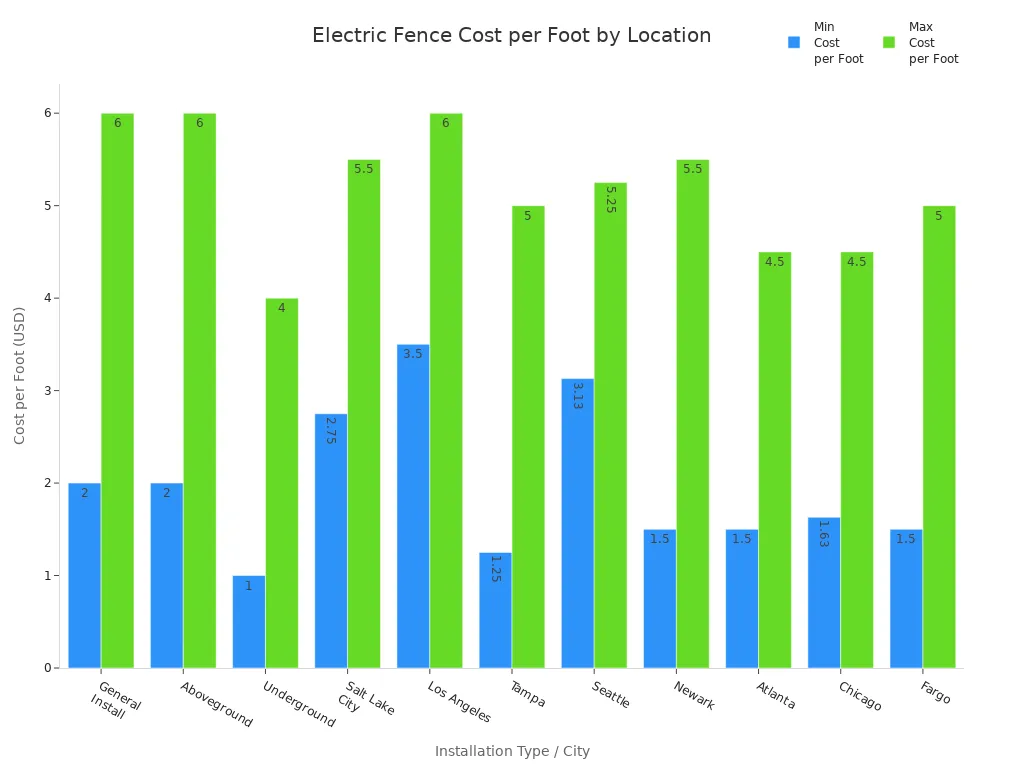
Installation Type / Location | Cost Range per Linear Foot or for 200 ft |
General electric fence installation (materials + labor) | $2 to $6 per linear foot |
Aboveground electric fence | $2 to $6 per linear foot |
Underground electric fence | $1 to $4 per linear foot |
Salt Lake City, Utah (200 ft fence) | $550 to $1,100 total ($2.75 to $5.50 per ft approx.) |
Los Angeles, California (200 ft fence) | $700 to $1,200 total ($3.50 to $6 per ft approx.) |
Tampa, Florida (200 ft fence) | $250 to $1,000 total ($1.25 to $5 per ft approx.) |
Seattle, Washington (200 ft fence) | $625 to $1,050 total ($3.13 to $5.25 per ft approx.) |
Newark, New Jersey (200 ft fence) | $300 to $1,100 total ($1.50 to $5.50 per ft approx.) |
Atlanta, Georgia (200 ft fence) | $300 to $900 total ($1.50 to $4.50 per ft approx.) |
Chicago, Illinois (200 ft fence) | $325 to $900 total ($1.63 to $4.50 per ft approx.) |
Fargo, North Dakota (200 ft fence) | $300 to $1,000 total ($1.50 to $5 per ft approx.) |
![Bar chart comparing minimum and maximum electric fence installation costs per foot across different cities and installation types.]()
Pros:
Cheap and easy to move or put up
Works for many animals like cattle, pigs, and sheep
Makes animals afraid to touch the fence
Cons:
Needs to be checked often to make sure it works
Not as easy to see as some fences
Animals must learn to stay away from the fence
Electric fences are good for moving animals and short-term use. Using both electric and real fences keeps animals safer and stops escapes.
Note: Electric fences help real fences by teaching animals to stay inside.
Cable Fences
Cable fences use strong steel cables or polywire between posts. These fences are easy to see and can bend without breaking. Some cable fences use electricity for more control.
Aspect | Details |
Livestock Species | Cattle and calves benefit most from cable fences (polywire, polytape). These fences are effective for containing well-behaved livestock, especially cattle and calves, which can be trained to respect electric fences. |
Cable Fence Types | Polywire (polyethylene with stainless steel strands), Polytape (woven plastic with wire filaments). Polywire with 6 or 9 strands is used for longer runs; polytape is more visible and easier for animals to see. |
Typical Failure Points | Inadequate grounding causing weak shocks; corrosion at metal junctions; vegetation contact causing power leakage; improper post placement or insufficient post depth; internal resistance limiting effective fence length. |
Fence Construction Tips | Use at least three ground rods (6-8 feet long) spaced 10 feet apart; proper post depth; sturdy corner and gate posts; avoid mixing metals to prevent corrosion. |
Wire Spacing for Cattle | 1 wire: 26-32 inches above ground; 2 wires: 18-24 and 24-36 inches; 3 wires: 11-18, 23-30, 34-44 inches. |
Pros:
Easy to put up and can bend without breaking
Animals can see the fence, especially with polytape
Good for cattle and calves
Cons:
Cable fences are best for trained cattle and moving animals around.
Mesh Fences
Mesh fences use wire woven tightly with small holes. This makes a strong fence that keeps animals in and stops predators.
Pros:
Small holes stop predators from getting in
Simple to put up and take care of
Can be changed for different animals
Cons:
Mesh fences are good for sheep, goats, and chickens. The small holes stop even tiny animals from getting out.
Note: Mesh fences keep out predators better than chain link because the holes are smaller.
Chain Link
Chain link fences use steel wires twisted into a diamond shape. These fences are strong and easy to see.
Pros:
Lasts a long time, often 15 to 20 years or more
Does not rust easily, especially if coated
Needs little care and is not expensive
Cons:
Big holes can let predators reach in
Not as safe at gates or the bottom
Small animals might get out
Chain link fences are good for animal pens, crops, and keeping wild animals out. If built well, they can last 30 years or more.
Vinyl Fences
Vinyl fences use plastic rails and posts to make a smooth, nice-looking fence. These fences are safe for animals and look neat.
Vinyl fences need little care, just cleaning sometimes.
After storms, check for loose or broken parts.
Check and fix gates after bad weather.
Fix small cracks or loose rails quickly to keep the fence strong.
Vinyl fences do not rot, get bugs, bend, or fade in the sun.
No need to paint or stain vinyl fences.
Vinyl fences can last 20-30 years or more with little work.
Pros:
Very strong and stands up to bad weather
Easy to clean and needs little care
Safe for animals, with no sharp parts
Cons:
Vinyl fences are common on horse farms and places that want a clean look.
Virtual Fencing
Virtual fencing uses GPS collars and wireless signals to make invisible lines. Animals wear collars that beep or give a small shock if they get too close to the edge.
Pros:
Cons:
A study showed virtual fencing kept Angus cows in one area for 139 days with few escapes. The cows learned to listen to the warnings and were as healthy as with electric fences. Virtual fencing is best for cattle and big fields where you need to move the fence.
Note: Virtual fencing lets farmers control animals without building real fences.
Comparing Fence Types
Effectiveness
Different fences keep animals safe in different ways. Farmers pick fences that work best for their animals and land. Some fences are better for certain animals or places.
Virtual fencing works well for cattle after they learn. Most cattle stay inside the invisible line, but some may cross at first. Virtual fencing lets farmers change paddock size easily and watch animals in real time. It does not hurt animal health compared to other fences.
Electric fences stop animals from escaping too. Animals learn fast to stay away after a small shock. Both electric and virtual fences keep cattle inside about the same.
Woven wire and mesh fences block small animals and predators. The small holes stop animals from getting out or in.
Barbed wire is best for cattle but can hurt them if they push on it.
Board and vinyl fences are easy for animals to see. Horses and cattle respect these fences, but small animals might get through.
Fence Type | Number of Escape Events | Number of Escaped Animals | Animal Behavior and Welfare |
Electric Fence | 11 | 36 | No change in activity; quick recovery |
Virtual Fence | 8 | 17 | Slightly more rest; animals adapt quickly |
Note: Virtual and electric fences both keep cattle safe. They have few escapes and do not harm animal health.
Durability
How long a fence lasts depends on what it is made of, the weather, and how it is cared for. Some fences last longer and need less fixing.
Fence Type | Average Lifespan (years) | Durability Notes |
Hinged Joint Field Fence | 10 | Needs regular care; metal can rust; animals and wildlife may cause damage |
Barbed Wire Fence | 15 | Lasts longer with good galvanization; moderate upkeep required |
High-Tensile Fixed-Knot Wire | 30 | Strong materials; resists rust; needs little maintenance; longer life lowers total cost |
Cattle guards last 10 to 30 years, based on what they are made of and care.
Steel guards can rust if not checked. Concrete guards do not rust but can crack.
Good building and regular checks help fences last longer.
Wet weather, heat, and soil type can make fences wear out faster.
Tip: High-tensile wire fences last the longest and need the least fixing.
Maintenance
Taking care of fences keeps animals safe and saves money. Some fences need more work than others.
Wood fences need painting and fixing for rot or bugs.
High-tensile wire fences need tightening and checks for rust or sagging.
Electric fences need wires, posts, and power checked often.
Vinyl fences just need cleaning and quick fixes for cracks or loose rails.
Metal fences may need rust treatment and new paint.
Virtual fencing needs battery checks and software updates, but no repairs to the fence.
Farmers who check fences often find problems early and keep animals safer.
Cost
Fence costs include building and taking care of them over time. Some fences cost more at first but save money later.
Fence Type | Initial Installation Cost | Long-Term Costs and Maintenance |
PVC (Rigid Vinyl) | High upfront cost; professional installation | Minimal maintenance; UV resistant; long warranty |
Wood (Post & Rail) | Lower than PVC, higher than wire | Frequent painting, staining, and repairs; shorter life |
Wire (High-Tensile) | Lowest among major types | Needs tightening and repairs; moderate upkeep |
Metal (Steel/Aluminum) | High due to material and labor | Durable; may need rust treatment; long life |
Electric | Lower than traditional fences | Regular upkeep of electrical parts; ongoing costs |
Post and rail fences cost more to build and keep up.
High-tensile wire fences are cheap to put in and last a long time.
Electric fences are cheap to start but need regular checks.
Vinyl fences cost more at first but save money because they need little care.
Labor costs can make fences cost more, but hiring pros helps fences last longer.
Picking the right fence saves money and keeps animals safe for many years.
Choosing Livestock Fences
Livestock Species
Different animals need different fences to stay safe. Horses need fences that are easy to see and strong. Horses can get scared and run into fences. Strong fences help stop them from getting hurt. Near gates or food, horses need extra strong fences. Cattle do well with high-tensile wire or electric fences. Sheep and goats need fences with small holes, like woven wire or mesh. These fences keep them from escaping. Virtual fencing works for cattle and sheep. It does not stress them much. Farmers should pick fences that fit each animal’s needs.
Terrain and Climate
The land and weather change what fence works best. In hot, wet places like Central Texas, wood can rot and metal can rust. Galvanized metal, treated wood, and vinyl last longer in tough weather. The soil matters too. Clay soil gets bigger and smaller with rain and dry times. This can make fence posts loose. Farmers should use materials and ways to build that fit their land.
Predator Threats
Predators like coyotes and wolves can hurt animals. Fences should be at least 6 feet tall to keep them out. The bottom of the fence must be tight so animals cannot dig under. Electric fences with strong power work well against predators. Mesh and chain link fences help if they are built high and tight. Adding things like coyote rollers or fladry gives more safety, especially in small fields.
Stocking Density
When many animals are in a small space, fences must be stronger. Board, vinyl, or high-tensile wire fences are good for crowded areas. In big fields, lighter fences may be enough.
Budget
Farmers need to think about cost and quality. High-tensile wire and electric fences are cheaper to put up and fix. Vinyl and board fences cost more but last longer and need less work. Picking the right fence saves money over time.
Legal Requirements
Farmers must follow local rules for Livestock Fences. The Natural Resources Conservation Service has rules for building and caring for fences. These rules help protect nature and let farms join government programs. Farmers should check local laws before building fences.
Tip: Always pick fences that fit your animals, land, and local dangers for the best results.
Fence Security Tips
Installation
Putting up fences the right way helps them last longer. It also keeps animals safe. Farmers should measure the land and mark where posts will go. They need to pick materials that fit the animals, land, and weather. Posts should go deep in the ground, sometimes with concrete, so they do not move. Good spacing and deep posts stop fences from leaning or falling. High-tensile wire must be tight so it does not sag. At corners and gates, use thicker posts and diagonal bracing for more strength. Gates should open and close easily and latch tight. Electrified strands can stop animals from pushing on the fence. This keeps the fence strong and stops damage.
Inspection
Checking fences often helps find problems early. Farmers should walk along the fence every week. They look for loose wires, broken boards, or posts that lean. Checking for rust, rot, or bugs keeps the fence in good shape. Plants growing on or near the fence can cause rust or make wires sag. Cutting grass and removing plants helps stop this. Farmers should also check electric fences for power and test the voltage. Teaching family or workers how to check and fix fences makes care easier.
Tip: Fixing fences fast after storms or animal damage stops bigger problems.
Upgrades
Making fences better helps keep animals safe and saves money later. Farmers can use high-tensile wire for more strength and flexibility. Adding electric fencing gives a safe shock so animals stay away. Woven wire or mesh fencing works well for small animals and keeps predators out. Using treated wood posts and sleeves helps posts last longer. Farmers can add solar lights or signs so fences are easy to see. Burying poultry fencing underground stops predators from digging in. Gates should be wide enough for equipment and animals to get through.
High-tensile wire and electric fencing make fences stronger and safer.
Woven wire and mesh fencing stop escapes and keep out predators.
Treated wood posts and sleeves help fences last longer.
Picking the best fence keeps animals safe and healthy. Farmers need to think about their land and what animals they have. They should also look at dangers in their area before choosing. Strong fences stop animals from getting out and keep out unwanted guests.
FAQ
What type of fence works best for keeping out predators?
Woven wire and mesh fences block most predators. Electric fences add extra protection. Farmers often use both for better security. Taller fences and tight bottoms help stop digging animals.
How often should farmers inspect livestock fences?
Farmers should check fences at least once a week. After storms or animal escapes, they need to inspect right away. Regular checks help find problems early and keep animals safe.
Can one fence type work for all livestock?
No single fence fits every animal. Horses need visible, strong fences. Sheep and goats need small openings. Cattle do well with high-tensile or electric fences. Farmers must match fences to each animal’s needs.
Are electric fences safe for animals?
Electric fences give a quick, mild shock. This teaches animals to avoid the fence. The shock does not harm healthy animals. Farmers must check the voltage to keep it safe.